

BUT Géologie offers its clients a comprehensive range of geophysical exploration solutions tailored to diverse contexts.
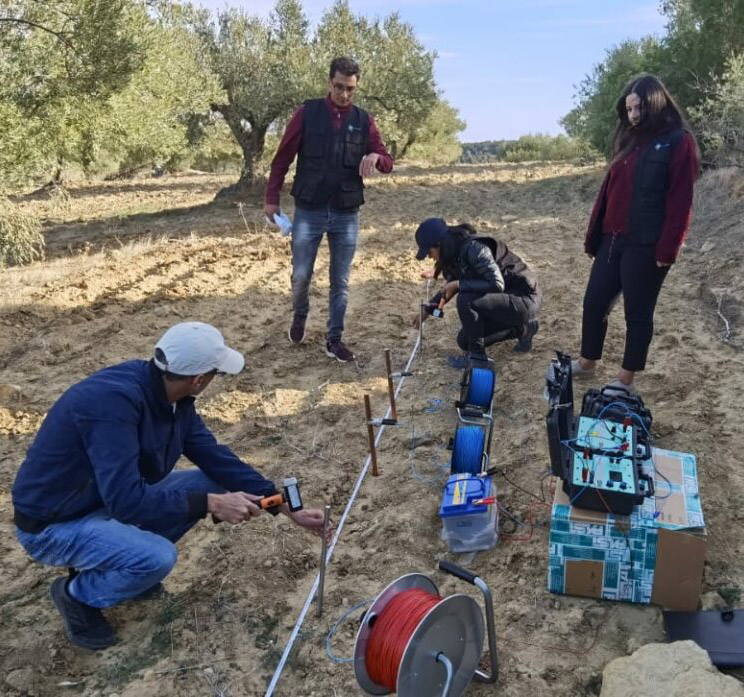
Electrical methods
Electrical methods are based on the study of the distribution of electrical potential in the subsurface. Measuring the electrical resistivity of the ground provides both qualitative and quantitative information. Geological interpretation of these results enables the differentiation of intact rock masses, altered zones, water-saturated areas, and natural geological faults.
Seismic methods
Seismic methods, widely used in civil engineering, allow the assessment of the thickness of easily excitable layers and the precise location of the roof of compact bedrock. They are also effective in identifying unconsolidated or karstified zones within limestone or evaporite formations. Additionally, BUT Géologie conducts impact studies of blasting operations near urban areas or other infrastructures to define the most appropriate technical and safety measures.
Ground-Penetrating Radar (GPR)
Ground-Penetrating Radar is a non-destructive technique based on the analysis of the propagation (refraction, reflection, and diffraction) of high-frequency electromagnetic waves. The use of frequency-domain GPR, a recent technique subject to specific instrumental constraints, is the focus of extensive research and has applications in various fields such as archaeology, hydrogeology, strategic studies, and civil engineering.
